
You're Closer to Meditating Than You Think
One-minute practices you can do anywhere, anytime
One of the biggest misconceptions people have about meditation is that it requires a significant chunk of time, a special room, a cushion, maybe some kind of training. And while a longer, more dedicated practice is wonderful and worth working toward, I want to let you in on something that has genuinely changed how I move through my days: mini-meditations.
Two minutes here. Thirty seconds there. These little pockets of awareness, woven into the ordinary moments of your day, are real meditation. And no one around you even has to know you're doing it.
Life is a succession of little moments, inner and outer. The more alert we are in our senses, the more we notice the texture of the world around us and within us. The point of meditation is to see the world with fresh eyes, to become a person upon whom nothing is lost. And that is exactly what these mini-moments do. They wake you back up to your own life.
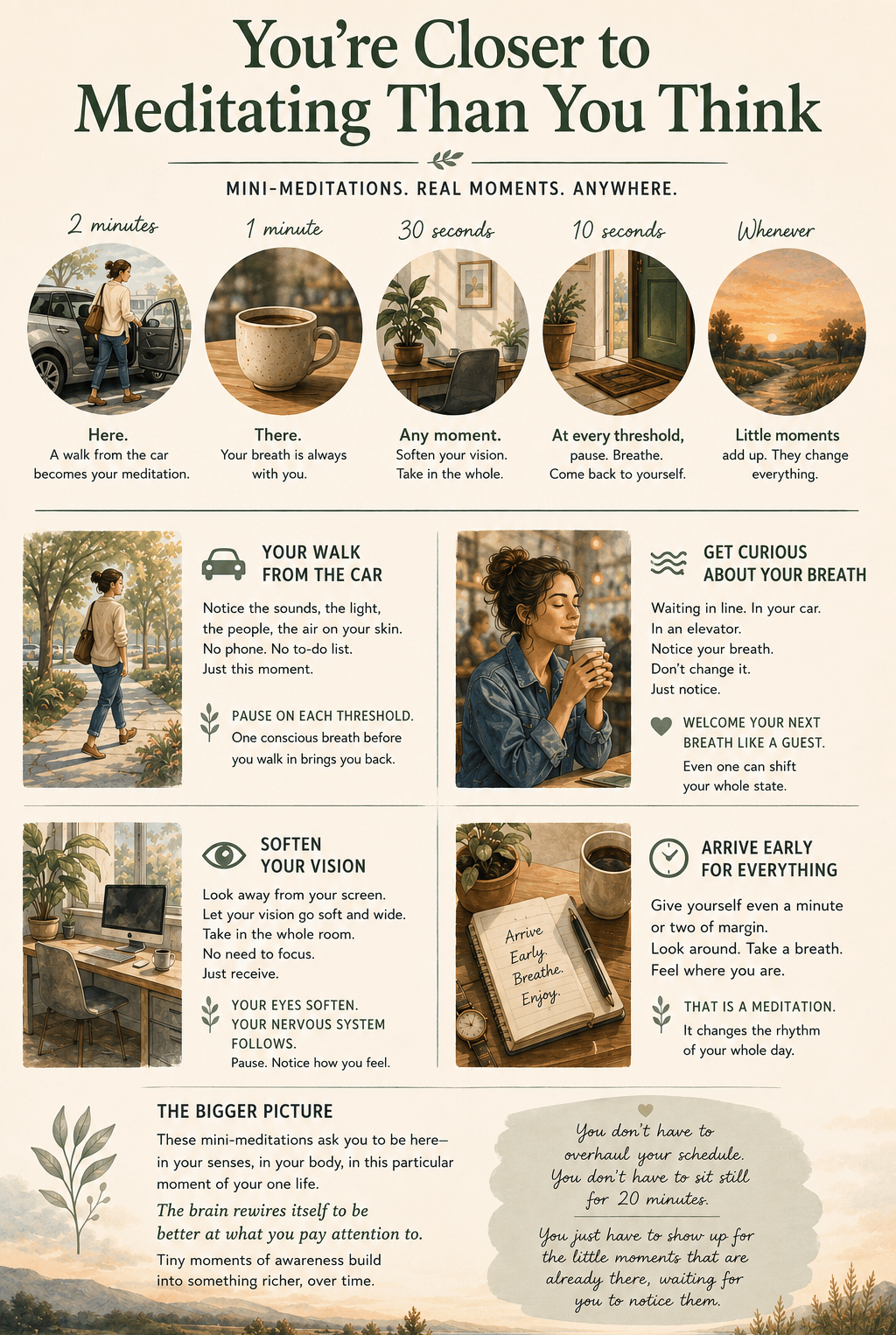
Your Walk from the Car
The next time you walk from your car to wherever you're going, let that short walk be your meditation. Notice what's around you. The sounds, the light, the people passing by, the temperature of the air on your skin. Take it all in without judging any of it.
There's another simple practice that fits beautifully here: pause on each threshold. Pay attention to your body when stepping across any boundary, any doorway, any entrance. Pause at a door, take a conscious breath, notice how you feel before you walk in. This pause lets you catch up with yourself as you enter. So often we are ten steps ahead of where we actually are. This simple pause brings you back.
Get Curious About Your Breath
Waiting in line at the coffee shop, sitting in your car before you go inside, those few seconds in an elevator: any of these is an opportunity to get curious about your breath. Not to control it or change it, just to notice it. Feel how it gently enters through your nose and then the air slowly flows out.
Think about some of the times in your life when you've found yourself appreciating the act of breathing. Walking outside on a crisp morning. Saying "Whew" at a moment of relief. Inhaling something delicious and letting out an "Mmmmmm." That appreciative, wondering quality, turning toward your breath with curiosity rather than discipline, is itself a meditation.
Try welcoming your next breath rather than just taking it. Not forcing anything, just leaning in the way you'd welcome a guest into your home. Even one conscious breath taken that way can shift something.
Soften Your Vision
This one is my favorites, especially after spending long hours at a computer. At any point during your workday, try this: look away from your screen and let your vision go soft and wide. Instead of focusing on anything in particular, take in the whole room at once. Let your peripheral vision open up. Notice the space, the light, the shapes around you without grabbing at any of them with your eyes.
Experience being receptive to what you’re seeing, rather than reaching out to grab the world with your eyes. Your eyes soften, your nervous system follows.
Pause there. Notice how you feel.
Arrive Early for Everything
This one might surprise you as a meditation tip, but it’s a lovely practice whenever I remember to do it. If you are even a little early for the events of your day, you can take a moment to breathe, feel yourself, and enjoy. One minute here and there can change the whole rhythm of a day by allowing you to catch up with yourself. And it makes the journey a lot more relaxing too!
When you're rushing from thing to thing, slightly out of breath, there's no space for anything. But when you arrive with even two minutes to spare, you can look around, take a breath, feel where you are. That is a meditation.
The Bigger Picture
What all of these practices have in common is that they ask you to be here, in your senses, in your body, in this particular moment of your one life. The brain actually rewires itself to be better at what you pay attention to. When you exercise a sense, even briefly, the brain creates more neural pathways for it. Over time, these tiny moments of awareness build into something richer.
You don't have to overhaul your schedule. You don't have to sit still for 20 minutes. You just have to show up for the little moments that are already there, waiting for you to notice them.
For more tiny meditations and everyday practices, I love Dr. Lorin Roche's Meditation Made Easy. Lorin was my long-time teacher, and many of the practices I teach come from his insightful work.
meditationcompass@gmail.com

© 2026 Yelena McElwain, Meditation Compass LLC